
Last updated October 15, 2026
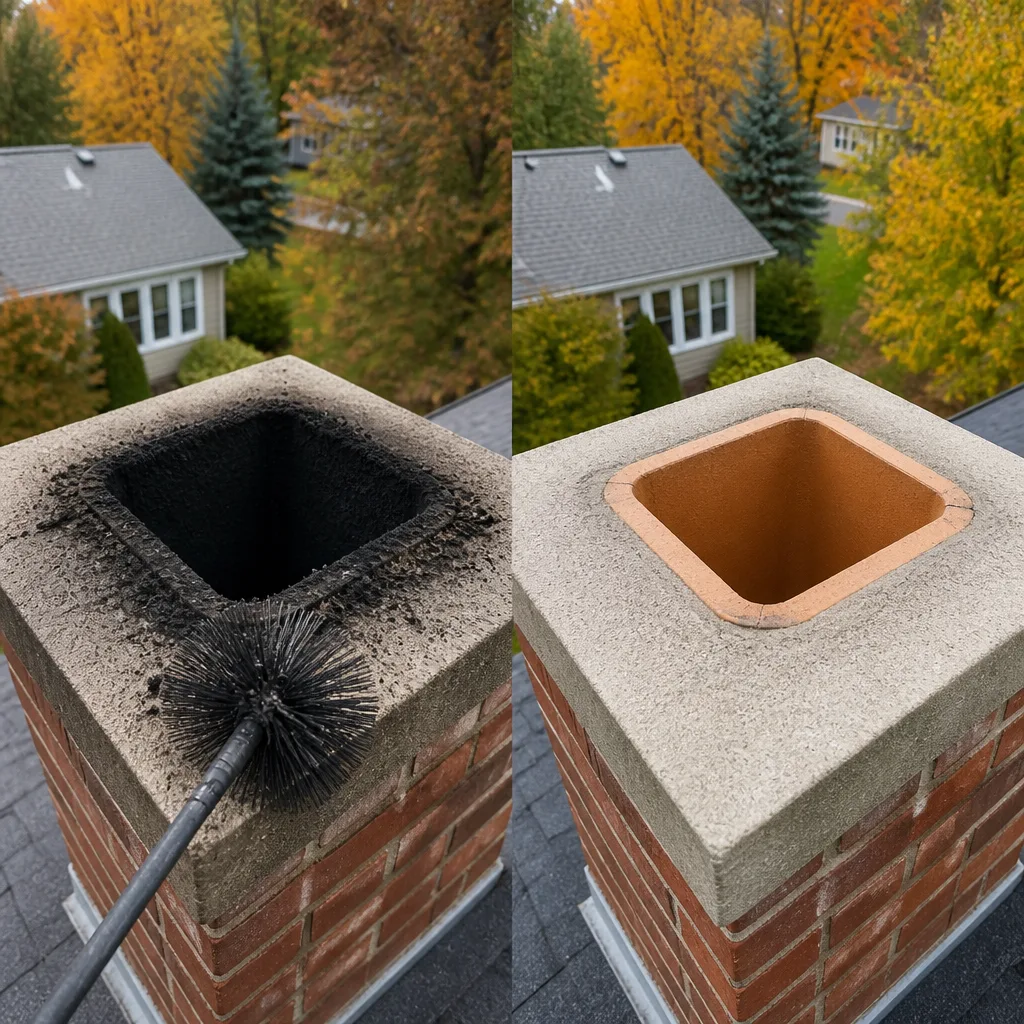 Sweep & inspection
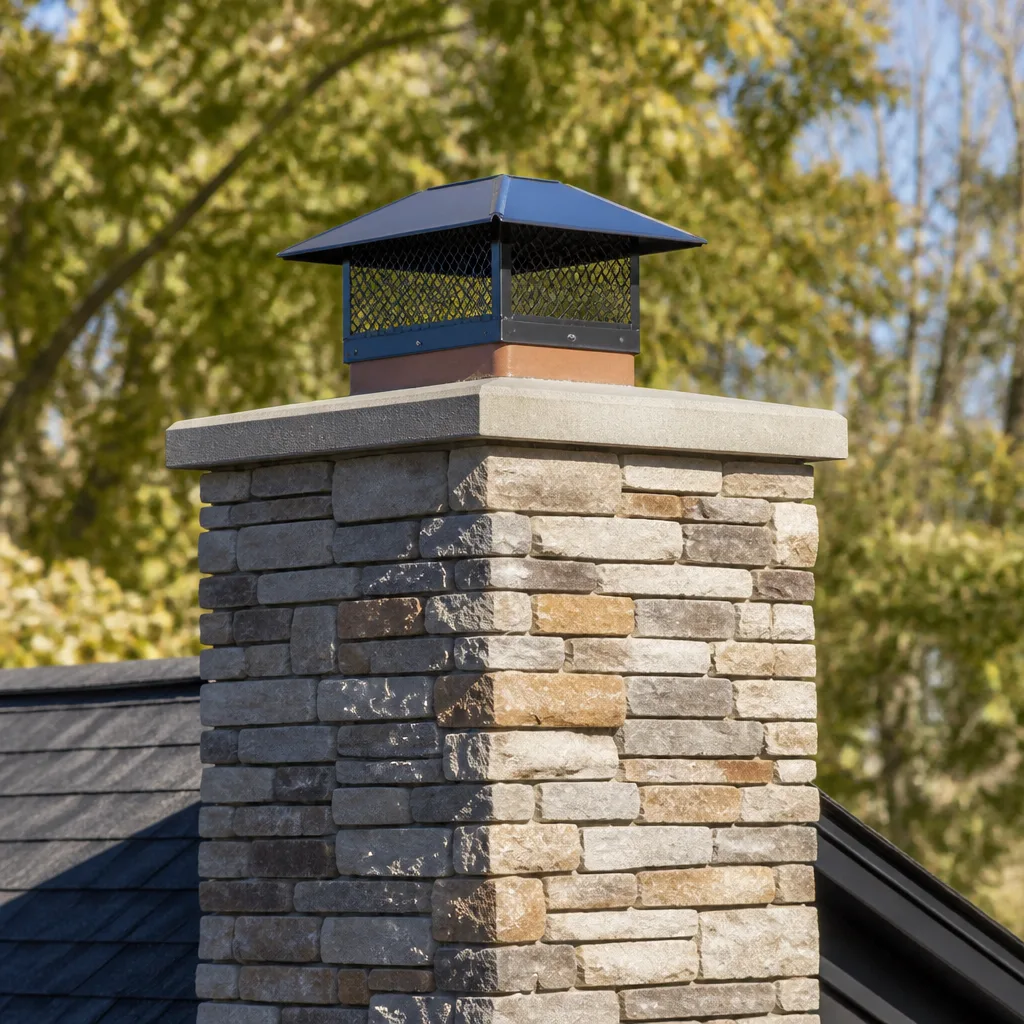 Caps & crowns
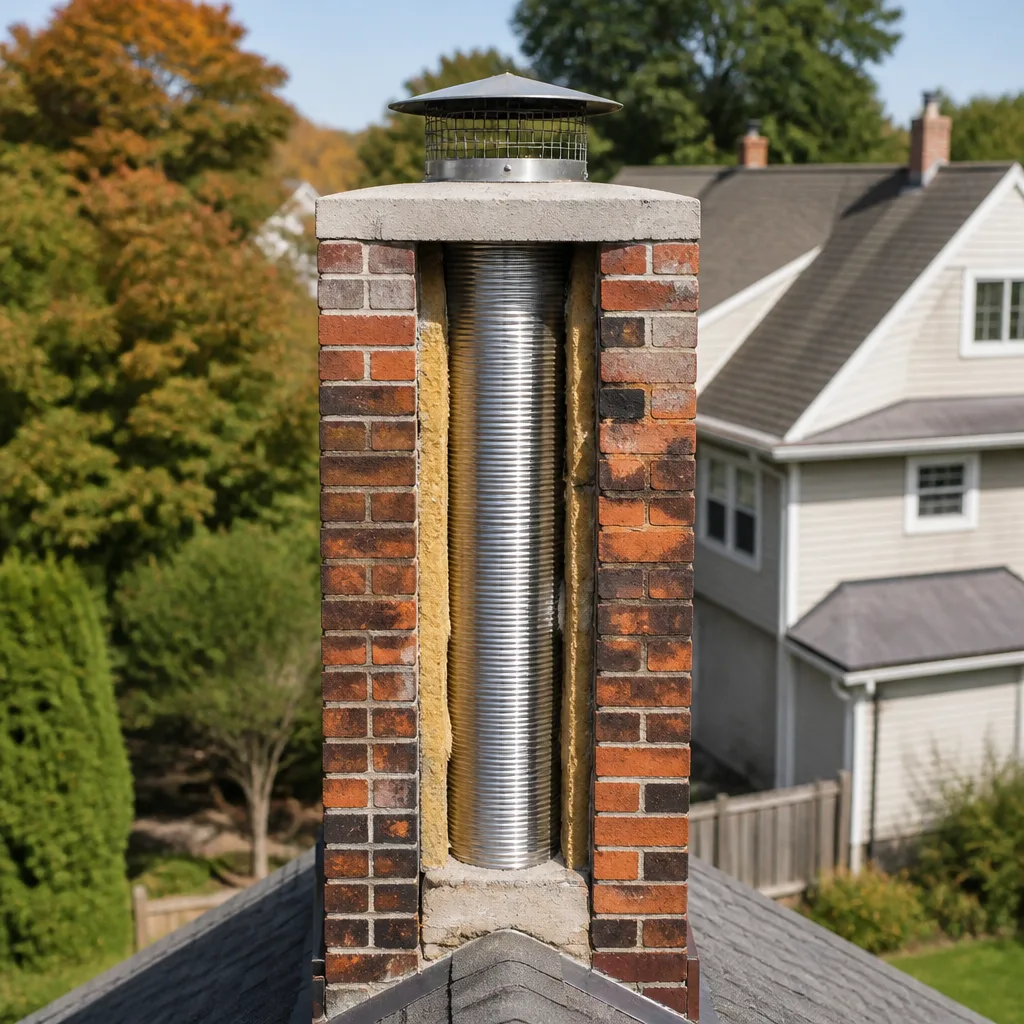 Flue relining
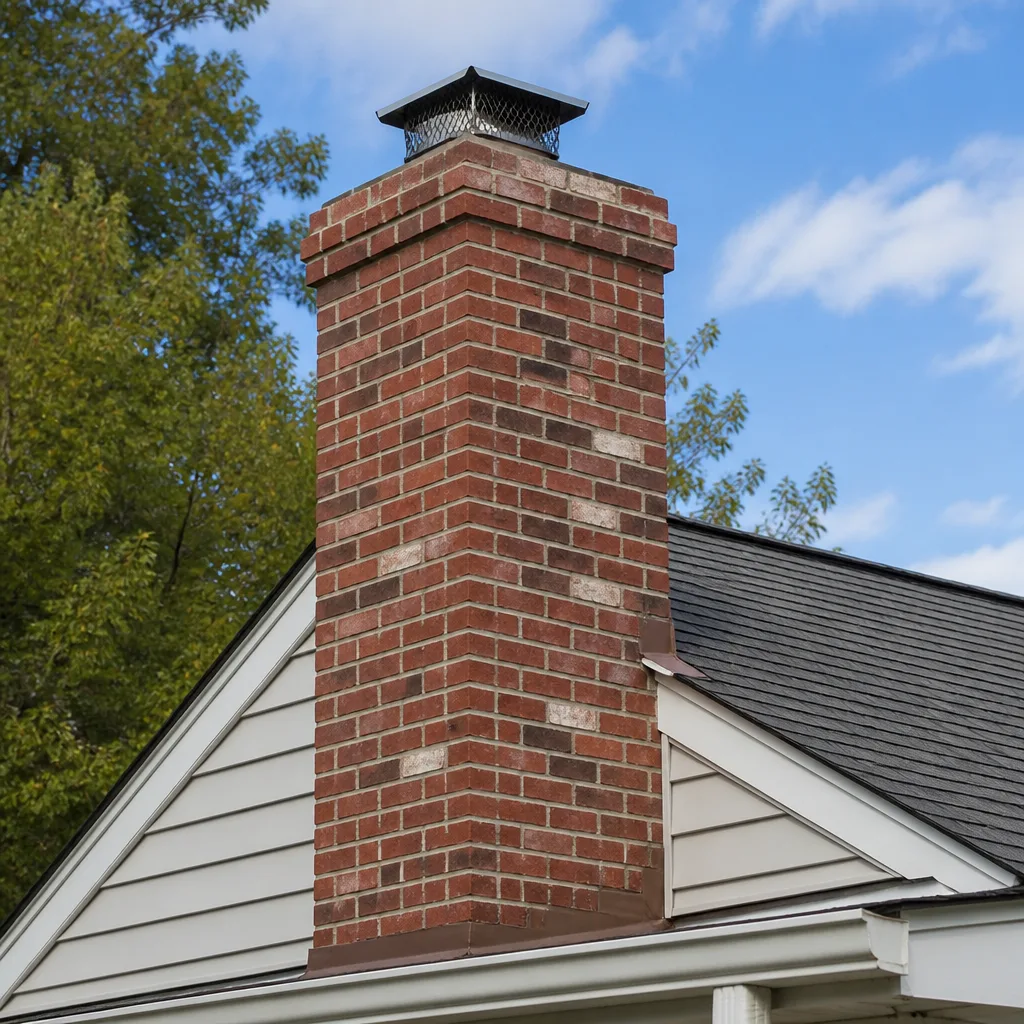 Masonry repair
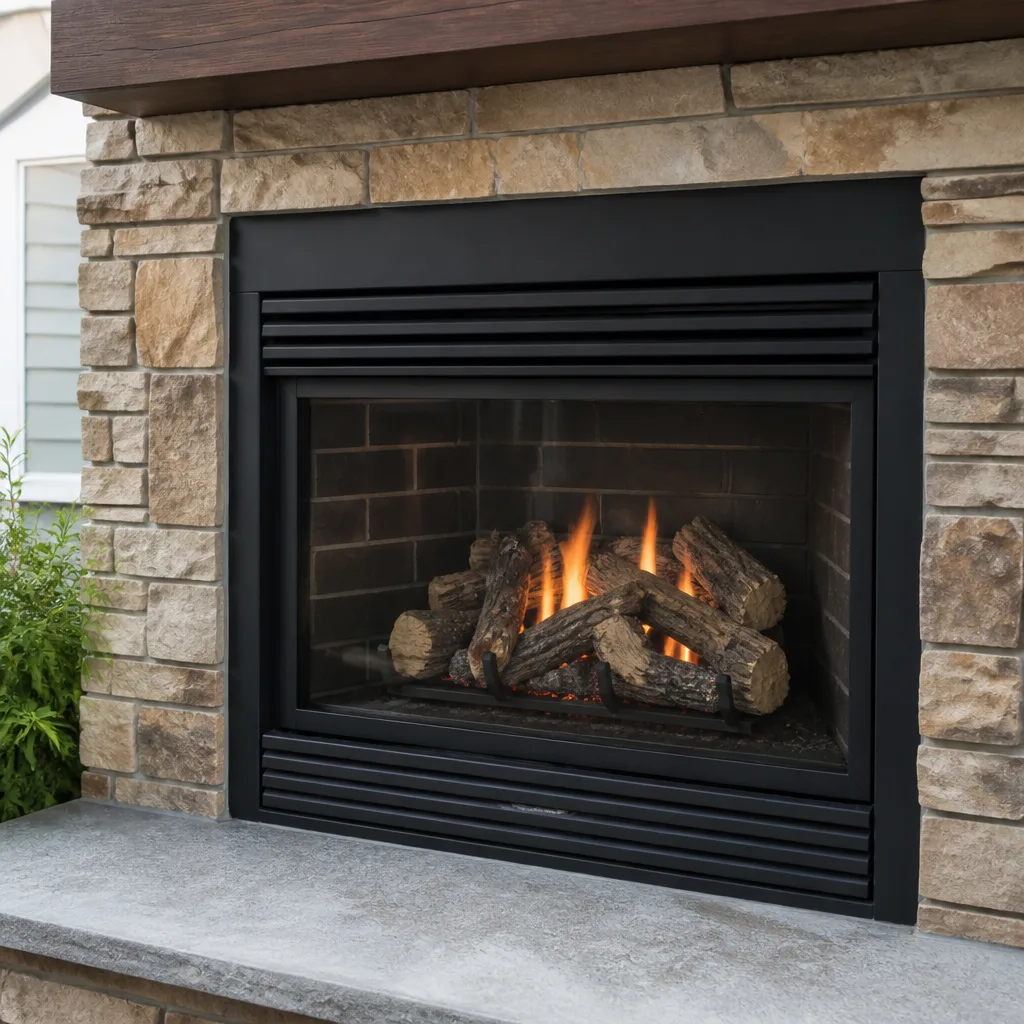 Gas fireplace service
Level 1 sweep and inspection to the NFPA 211 annual standard - flue, crown, cap, and flashing checked and photographed
Chimney sweep logs do not sweep chimneys. They loosen some creosote - which then falls where a brush and vacuum still have to collect it.
Chimney Sweep Maintenance Checklist for Santa Clarita Homeowners
Most chimney checklists online read like they were written by someone who has never actually looked inside a firebox. They tell you to “inspect your chimney annually” without explaining what an inspection actually involves, or which parts you can safely check yourself and which parts require a trained sweep with camera equipment and a headlamp. For The Complete Guide to Chimney Cleaning in Santa Clarita and more context, see our related resources. This guide is built around a single question: after you run through it, will you know whether to pick up the phone or not? By the time you reach the bottom of this page, you’ll have a working knowledge of the exact tasks a professional sweep performs in Santa Clarita, the specific signs of trouble you can spot from your living room floor, and a clear-eyed sense of what a properly maintained chimney should cost you here in the Santa Clarita Valley.
Quick Answer
A chimney maintenance checklist for Santa Clarita homeowners comes down to three things: know what you can safely check from the firebox without climbing onto your roof, understand what creosote and weather damage actually look like in our specific climate, and schedule our Chimney Sweep services once a year before you light your first fire. We recommend a visual check every 6 to 8 weeks during burning season, and a full sweep plus camera inspection every 12 months. The annual visit is the one that matters most, because that’s when a trained eye catches what a visual glance from the hearth will always miss.
Styles & brands we work with
Table of Contents
- What a Chimney Maintenance Checklist Actually Covers
- DIY Visual Checks You Can Do From the Firebox
- Checks That Require a Professional Sweep
- Understanding Creosote Stages: First-Stage vs Second-Stage
- Santa Clarita-Specific Wear: Stucco, Clay Tile Liners, and Sun
- Damper Inspection and Testing
- Pre-Season Sign-Off Checklist: What a Guarantee-Backed Sweep Includes
- Common Mistakes to Avoid
What a Chimney Maintenance Checklist Actually Covers
A working chimney maintenance checklist has two halves. The first half is what you, the homeowner, can do from the floor of your firebox with a flashlight and a pair of eyes. The second half is what requires a professional: camera inspection of the flue interior, physical removal of creosote deposits, measurement of clearances, and judgment about whether the liner, crown, or chimney structure can safely carry another season.
The National Fire Protection Association standard (NFPA 211) is the benchmark every reputable sweep in Santa Clarita works to. It says chimneys, fireplaces, and vents should be inspected at least once a year, and cleaned when creosote deposits reach 1/8 inch or more. That 1/8 inch figure is the actionable line. Visual buildup of creosote that thin is enough to sustain a chimney fire, and it’s the threshold where the NFPA says a cleaning is mandatory, not optional.
What most checklists fail to say plainly is this: you cannot see the flue interior from your living room. You can see the firebox, the damper, and the first few feet of the smoke chamber if you angle a flashlight correctly. That’s it. Everything above the damper is invisible without a professional inspection. A good checklist respects that boundary. It doesn’t pretend the homeowner can do the sweep’s job, and it doesn’t leave the homeowner helpless either.
Here in Santa Clarita, the checklist is shaped by two things that most generic national checklists ignore: our climate and our housing stock. We get hot, dry summers that bake chimney crowns and crack mortar. We get wind events in the fall that drive debris down open flues and lift chimney caps if they’re not properly secured. And a large share of homes in Valencia, Newhall, Canyon Country, and Saugus were built with stucco-clad chimneys and clay tile liners, both of which wear in ways specific to this region. A Santa Clarita checklist has to account for those realities, not just creosote numbers.
DIY Visual Checks You Can Do From the Firebox
These are the checks you can do yourself, safely, without climbing onto your roof. You need a flashlight, a small mirror if you have one, and about ten minutes when the firebox is completely cold.
- Shine the flashlight up past the damper. Look for any visible coating on the flue walls. Light tan or brown fuzz means first-stage creosote, which is normal after some burning. Black, shiny, or tarlike coating means second-stage or third-stage creosote, which is not something to wait on.
- Inspect the firebox walls and floor. Look for cracked firebrick, missing mortar joints, or white powdery staining. The white staining is called efflorescence and it signals water intrusion through the masonry, a common finding in Santa Clarita stucco chimneys after a wet winter.
- Check the damper plate and frame. Open and close the damper. It should move freely without scraping or sticking. A damper that catches likely has warped metal from heat exposure or rust from moisture coming down the flue.
- Look for debris at the base of the flue. You shouldn’t see leaves, twigs, or small pieces of mortar at the bottom of the firebox. If you do, it means the chimney cap is damaged or missing, or the crown is spalling and sending chunks down the flue.
- Sniff the firebox on a humid morning. A strong campfire smell in spring or summer, when you haven’t burned in months, indicates creosote accumulation pulling moisture from the air. That odor is a sign the flue needs cleaning before the next season.
- Check for daylight around the damper. With the damper closed on a bright day, you should not see light sneaking around the edges. If you do, the damper isn’t sealing, and your house is losing conditioned air up the chimney.
These six checks take minutes and cost nothing. They won’t replace a professional inspection, but they will tell you whether to schedule a sweep now or whether you have some runway. In our experience across Santa Clarita, homeowners who do these basic checks every couple of months catch problems at the first-stage creosote level, when a standard sweep handles it. The ones who skip them end up with third-stage creosote and a much larger bill.
Checks That Require a Professional Sweep
There’s a line between what you can safely eyeball and what requires a trained sweep. That line is drawn at the damper. Everything above it, the flue liner itself, the smoke chamber, the chimney crown, and the cap, requires either roof access or camera equipment to evaluate correctly. That’s not a sales pitch. That’s a description of what’s physically possible.
Here’s what a professional sweep in Santa Clarita checks that you cannot:
- Flue liner condition. Clay tile liners crack. Stainless liners corrode at the seams. The only way to see the condition of the liner across its full length is a camera inspection, also called a Level 2 inspection. Hairline cracks in clay tile are invisible to the naked eye even if you could get your head in the flue, which you shouldn’t try.
- Creosote thickness and stage. A sweep uses specialized brushes and a vacuum system to remove creosote, then measures what was removed and records the stage. Sooty first-stage creosote brushes out easily. Glazed third-stage creosote requires chemical treatment or rotary cleaning with chains, and that’s a different job with different pricing.
- Smoke chamber integrity. The smoke chamber is the funnel-shaped section between the firebox and the flue. In older Santa Clarita homes, these were built with corbeled brick that leaves voids and rough surfaces that trap creosote. A sweep inspects the smoke chamber for buildup and missing mortar, which most homeowners have never heard of and none can see from the ground.
- Crown and cap condition. The concrete crown at the top of the chimney takes direct sun and rain. In Santa Clarita, the UV exposure and hot summers accelerate crown cracking. A cracked crown lets water into the chimney chase, which damages the liner and can lead to costly masonry repairs. The cap has to be inspected for proper fit and screen condition to keep out birds, embers, and Santa Clarita’s seasonal winds from doing damage.
- Clearances to combustibles. In attic spaces, the chimney must maintain specific clearance to framing members. A sweep checks this during the inspection because it’s a code issue you can’t see from the living room or the roof.
If your Santa Clarita home has a factory-built fireplace instead of a traditional masonry chimney, the inspection still requires a professional, but it focuses on the pipe sections, the chase, and the termination cap. Different system, same principle: trained eyes, proper equipment, and a written report.
Understanding Creosote Stages: First-Stage vs Second-Stage
Creosote is the byproduct of wood combustion that condenses on the flue wall as smoke cools. It’s unavoidable. The question is never whether you’ll have creosote, but how much, what stage it’s reached, and whether it’s within a safe operating range.
First-stage creosote is what most Santa Clarita homeowners deal with. It looks like a light tan or brown dust or fuzz on the flue walls. It brushes off easily during a standard sweep, and it’s what we expect to find when a homeowner burns seasoned wood at reasonable temperatures and has made it through one burning season. First-stage creosote is normal. It’s manageable. It’s the stage that a regular annual sweep is designed to address.
You can often identify first-stage creosote from the firebox by shining your flashlight up toward the damper and looking for that dry, dusty, light-tan coating. It has a rough texture but no sheen. If you see that, your situation is routine. Schedule a sweep and you’re fine.
Second-stage creosote is a different animal. It appears as black, flaky, crunchy deposits that look like dried tar or coffee grounds bonded to the flue wall. It can look glossy in places. Second-stage creosote forms when burning temperatures are too low, wood is too wet, or the flue is oversized for the fireplace, which causes smoke to linger and cool before it escapes. It does not brush out with a standard sweep. It requires rotary cleaning with specialized wire or chain heads, and in some cases a chemical treatment to break down the glazed surface first.
Third-stage creosote is the worst: a hard, glossy, tarlike glaze that forms when second-stage creosote is repeatedly exposed to high heat. It’s condensed fuel. Third-stage creosote is what sustains chimney fires, because it’s essentially flammable material painted onto the inside of your flue. It’s the reason the NFPA sets that 1/8 inch cleaning threshold so conservatively. The cost difference between cleaning first-stage and third-stage creosote in Santa Clarita is significant. A standard sweep typical runs $180 to $300 depending on the size of the system and the amount of buildup. Third-stage creosote removal can double that, and sometimes requires a chemical treatment pass or two before the mechanical cleaning even starts.
Here’s the practical takeaway: check your firebox for visible creosote every few weeks during burning season. If it’s light tan and dusty, you’re in the normal range. If it’s black and flaky or shiny, stop burning and schedule a sweep. The line between first-stage and second-stage creosote is the line between a routine service call and a more involved job, and seeing that line early saves you money.
Santa Clarita-Specific Wear: Stucco, Clay Tile Liners, and Sun
Santa Clarita is not a one-size-fits-all market for chimney maintenance. Our specific combination of climate, housing stock, and seasonal conditions produces failure patterns we see across Valencia, Newhall, Saugus, and Canyon Country. Understanding these patterns helps you know what to watch for before it becomes a repair bill.
The first regional pattern is the stucco chimney. A large portion of Santa Clarita homes built in the 1980s through the early 2000s have stucco-clad wood-frame chimneys or stucco over masonry. Stucco is porous. Hot, dry summer months pull any residual moisture out of the material, and when the occasional heavy winter rain arrives, the water gets absorbed quickly, then expands and contracts through seasonal cycles. The result is hairline cracking in the stucco face, which lets water move into the chimney chase. Once water is inside, it finds its way to the wooden framing or the metal pipe inside, and that’s when you start seeing rust staining or water damage in the firebox.
Walk around your chimney exterior twice a year, once in spring and once in fall. Look for hairline cracks running vertically or diagonally through the stucco. Look for spalling, which is when small chunks of the surface pop off, leaving shallow craters. Look for rust-colored staining near the base or around pipe penetrations. Any of these signs signals water entry, and the fix is much cheaper in the crack-and-reseal stage than it is once the framing inside the chase starts to rot.
The second regional pattern is clay tile liner wear. Many Santa Clarita homes that have traditional masonry fireplaces were built with terra cotta clay tile liners stacked inside the flue. Clay tile is a fine material, and it lasts for decades when protected from water and sudden temperature swings. But Santa Clarita’s wildfire-adjacent air quality, coupled with residue from burning in the valley, can create acidic condensate on the liner surface. Over time, that condensate etches and weakens the tile. When the tile cools and heats, the weakened spot cracks. A cracked clay tile liner is a fire-safety issue because it no longer insulates the combustibles around the chimney from the flue gases.
This is why a camera inspection matters so much in Santa Clarita. Clay tile liners crack in places you can’t see, and the crack may be small enough at first to go unnoticed but significant enough to let heat and gases into the chimney chase. We’ve seen homes in Newhall with liners that looked fine on the top section but had longitudinal cracks running the full length of the lower section. The only way to find that is with a camera.
When a tile liner has failed, the repair is a relining, and that’s where the material brand matters. We work with DuraFlex stainless steel liners because they carry a strong manufacturer track record and they’re appropriate for the temperature ranges and fuel types common in Santa Clarita homes. For situations where full replacement isn’t necessary, a product like HeatShield can restore the existing flue with a ceramic coating. We specify by the job, not by a sales target, and we’ve installed and worked with both products enough to know which one fits which situation.
Damper Inspection and Testing
The damper is the one chimney component you interact with directly every time you build a fire. It’s the metal plate that opens to let smoke up the flue and closes to keep conditioned air in your house when the fireplace isn’t in use. A damper that doesn’t work correctly costs you money in two ways: it lets hot air escape up the chimney in winter and lets hot Santa Clarita summer air infiltrate the house in July and August.
Testing your damper is straightforward and requires no tools. Start with the firebox cold. Locate the damper handle, typically a metal lever or chain at the top of the firebox opening. Move it through its full range of motion. It should open and close smoothly without binding. If it catches, sticks, or requires force, the metal has likely warped from heat exposure or the hinge has accumulated rust.
With the damper closed, look up from inside the firebox. You should not see daylight sneaking around the edges of the damper plate. If you see light leaks, the damper isn’t sealing. That’s a problem in May through October when your air conditioner is running and you’re paying to cool air that’s escaping up the flue. It’s also a problem on windy days when outside air is pushed down the chimney and into your living room, carrying that campfire smell with it.
Some Santa Clarita homes have top-sealing dampers installed at the crown of the chimney rather than the traditional throat damper at the fireplace opening. Top-sealing dampers use a cable that runs down through the flue to a handle or lever in the firebox. The test is the same: operation should be smooth, and the seal should be tight. Top-sealing dampers generally seal better than throat dampers and keep Santa Clarita’s September and October heat out of the house more effectively, but the cable mechanism wears and can fail. If the handle feels loose or doesn’t move the damper at the top, the cable has likely disconnected.
A damper that’s mildly sticky can sometimes be cleaned with a stiff brush and a light lubricant on the hinge points. But a warped damper plate is a replacement item, not a repair item. If the plate doesn’t seat flush against the frame, no amount of cleaning will fix it. In that case, you’re looking at either a new throat damper or a conversion to a top-sealing damper. Both are common jobs in Santa Clarita, and neither requires rebuilding the firebox.
Pre-Season Sign-Off Checklist: What a Guarantee-Backed Sweep Includes
Every professional sweep should end with documentation. Not a handshake and a verbal “you’re all set,” but a written record of what was checked, what was found, and what was done. Here’s what the pre-season sign-off checklist at Flint Chimney Co Santa Clarita includes, and it’s a good benchmark for what to expect from any legitimate sweep in the Santa Clarita Valley.
- System identification. The sweep records the type of chimney system: masonry with clay tile liner, masonry with stainless liner, factory-built fireplace, or wood stove with connector pipe. If you don’t know what type of system you have, this is the document that tells you.
- Creosote measurement and removal. The sweep records the stage of creosote found before cleaning, the thickness at the worst point, the method used for removal, and the amount removed. This baseline matters for planning the next season. If the sweep finds 1/4 inch of second-stage creosote after one season, you need to adjust your burning practices or fuel quality.
- Flue liner condition report. This includes camera documentation if the inspection found anything concerning, and a written assessment of liner integrity. If the liner is sound, the report says so. If it’s not, the report should show you the images so you can see exactly what the sweep is seeing.
- Damper function test. The damper is opened, closed, checked for seal, and lubricated if needed. Any binding or warping is noted in writing.
- Crown and cap inspection. From the roof, the sweep examines the crown for cracks, the cap for proper fit, and the flue opening for any debris accumulation. In Santa Clarita, this is also where the sweep checks for sun and wind damage to the crown.
- Smoke chamber inspection. The sweep examines the smoke chamber for creosote buildup, missing mortar, and proper geometry. This is the area many homeowners never see and most cheap sweeps skip.
- Smoke test. At the end of the cleaning, the sweep should confirm draft with a smoke test, verifying that smoke moves up and out of the flue the way it should.
Here’s the Garrison Standard in practice: every one of these findings goes in writing before the work is signed off, and any repair we recommend carries a written guarantee for a full year. If a covered repair fails within that year, the second visit is free. No argument, no phone tree, no invoice. That’s the standard the Garrison Partners family of independently owned companies has operated under since 2002, and it’s the reason the checklist matters. A checklist with no written record attached is just a list. The record is what protects you.
Common Mistakes to Avoid
- Skipping the camera inspection to save money. A standard sweep without a camera inspection misses liner cracks that are invisible from the firebox. In Santa Clarita, where clay tile liners in older Newhall and Canyon Country homes are reaching the end of their service life, skipping the camera means missing the problem until it’s a fire-safety issue.
- Burning unseasoned wood. Wood that hasn’t dried for at least 6 to 12 months burns cooler and creates more smoke, which condenses into second-stage creosote faster. Santa Clarita’s firewood suppliers should be able to tell you the moisture content of what you’re buying. If they can’t, find another supplier.
- Treating a visual check as a substitute for a sweep. Your flashlight from the firebox can see the first 18 inches of the flue. Your chimney is 15 to 30 feet tall. The math doesn’t work. Visual checks are early-warning, not replacement.
- Ignoring water stains on the chimney exterior. Efflorescence and rust staining on stucco or brick are the first signs of water intrusion. In Santa Clarita, where the dry season gives the illusion that everything is fine, water problems hide for years and then surface in January and February as the worst possible time for masonry work.
- Waiting until the first cold week to schedule a sweep. October and early November are the busiest months for chimney service in Santa Clarita. Scheduling in August or September gives you the full menu of available dates and gets your system ready before the first fire in Valencia, Saugus, or wherever in the valley you happen to live.
- Assuming a new house means a sound chimney. We’ve inspected brand-new construction in Santa Clarita with improperly installed caps and insufficient clearances. New doesn’t mean correct. The inspection matters regardless of the home’s age.
See the difference
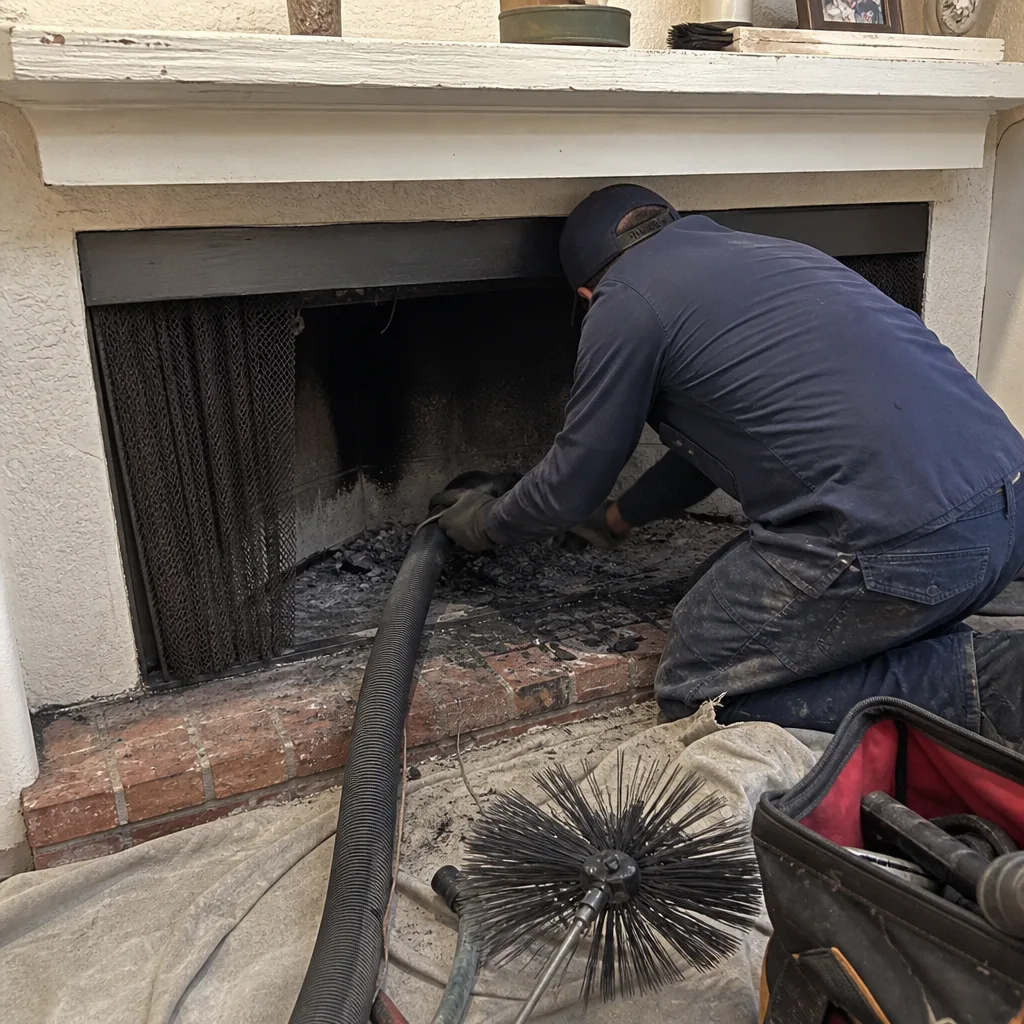 Before
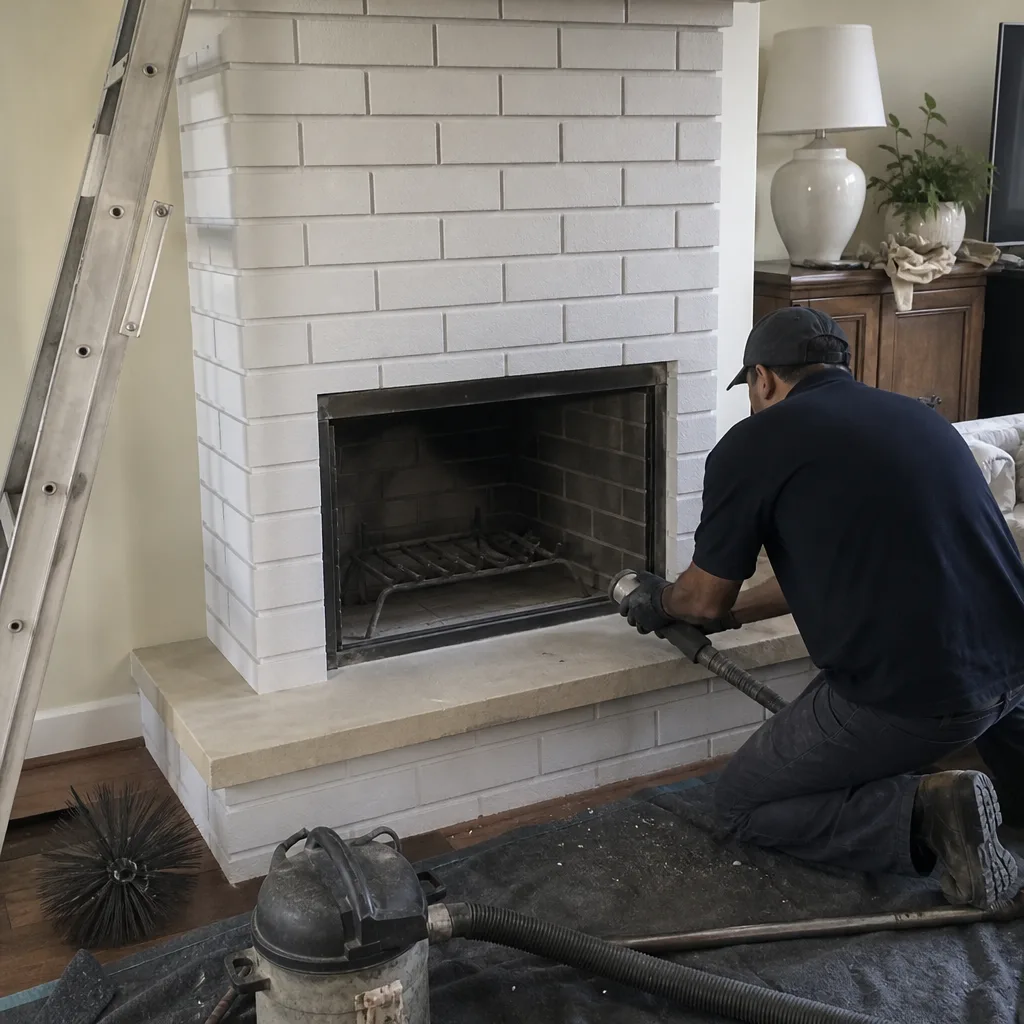 After
After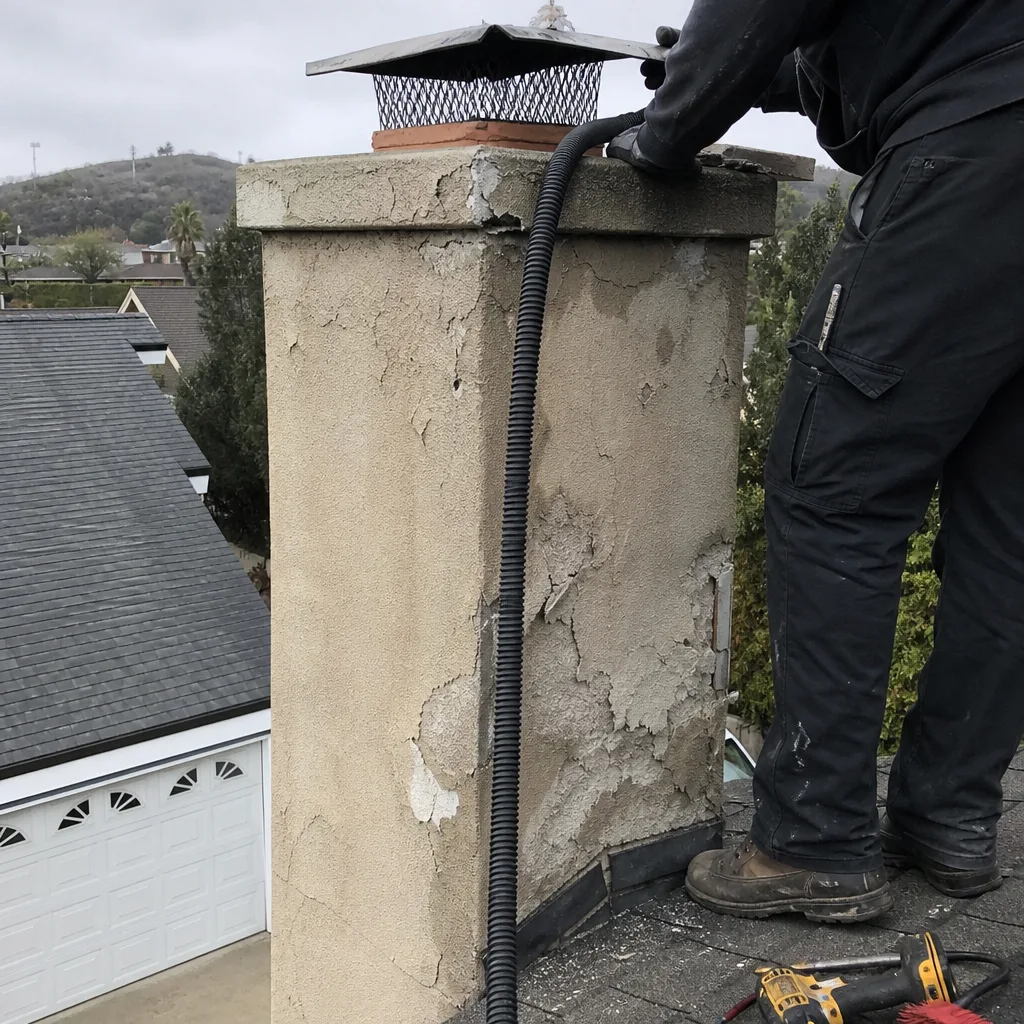 Before
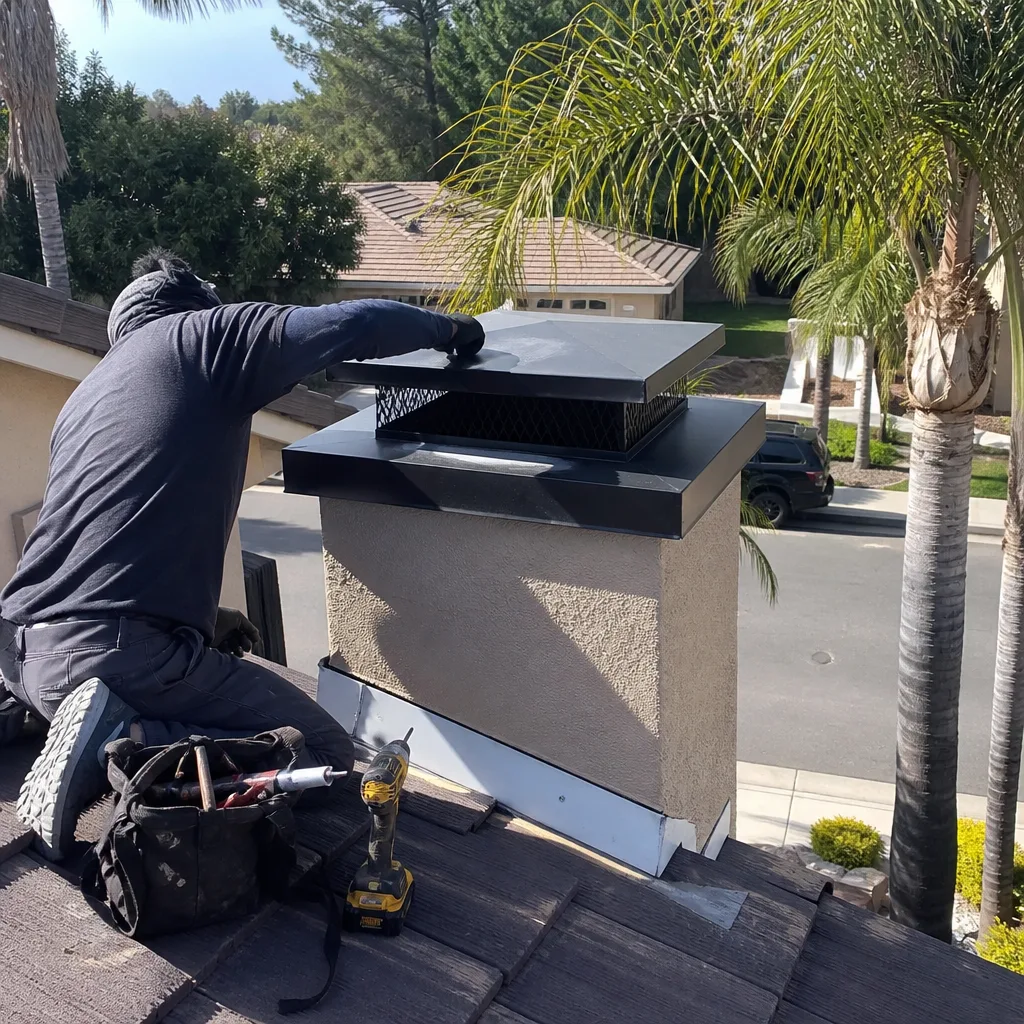 After
After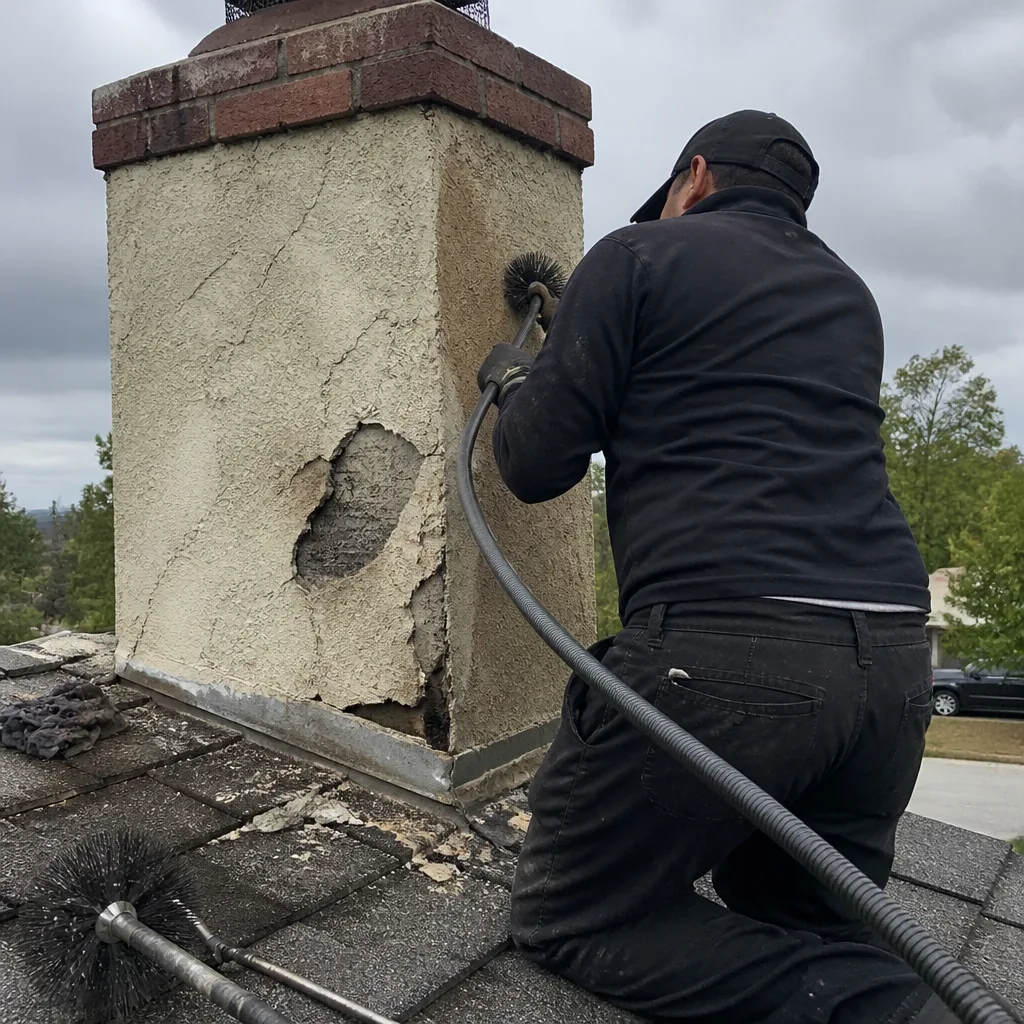 Before
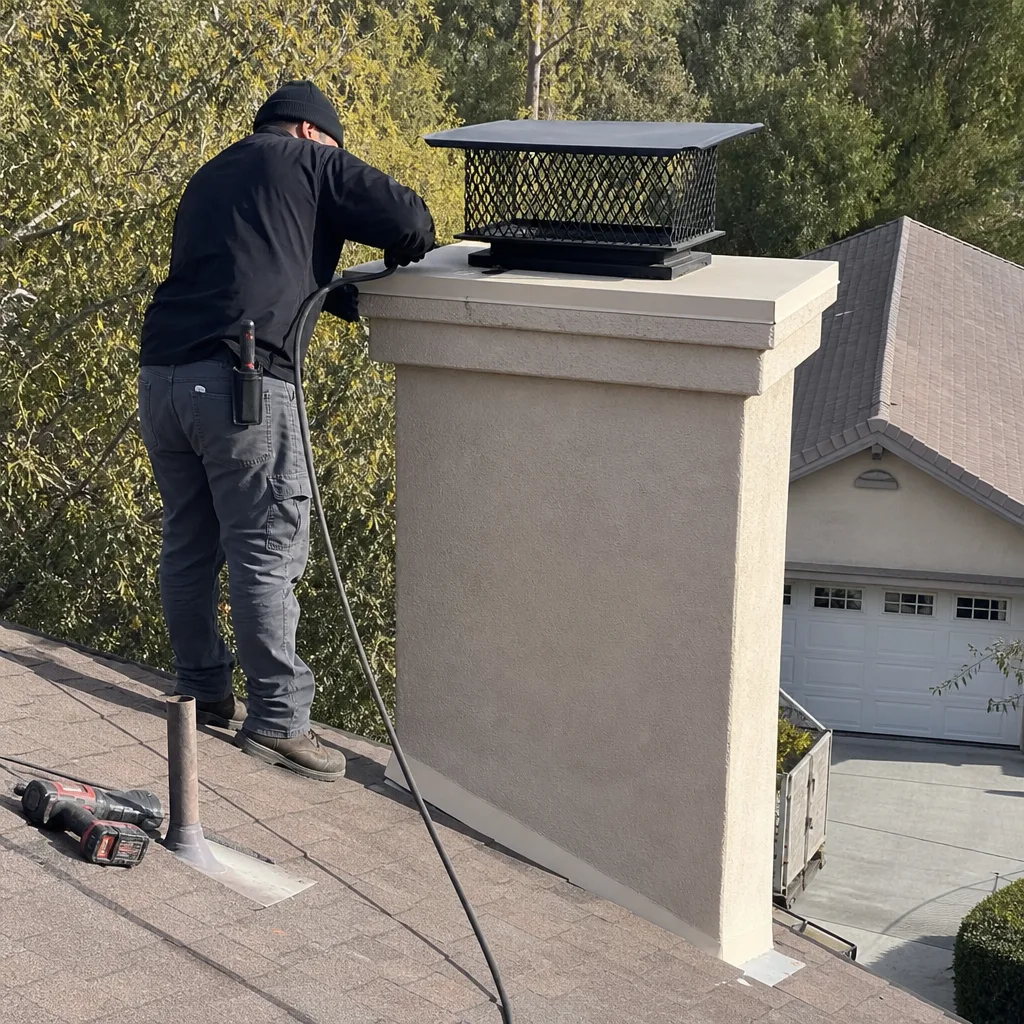 After
AfterWhen to Call a Professional
These are the situations where you stop reading checklists and make the call. You see black, shiny, or tarlike creosote on the flue walls when you shine your flashlight up from the firebox. You find pieces of mortar, clay tile, or rusted metal in the firebox that weren’t there before. You notice water staining on the ceiling near the chimney chase or on the wall behind the fireplace. You smell smoke in the house when the fireplace isn’t in use. You see cracks in the stucco chimney exterior that are wider than a hairline. Or you simply haven’t had the system inspected in over a year and you plan to burn this winter. Any one of these is enough. Flint Chimney Co Santa Clarita offers free estimates throughout the Santa Clarita Valley. Call (661) 430-6125 and we’ll get a uniformed, background-checked technician to your home, put the price in writing before any work starts, and back every repair with a full-year written guarantee. That’s how the Garrison Code works, and it’s the same at every Garrison Partners location.
We invite you to start with our Flint Chimney Co Santa Clarita home page if you want to see the full scope of what we cover. For specifics on what a cleaning involves, visit our Chimney Sweep in Santa Clarita service page. The Chimney Inspection in Santa Clarita page walks through the three levels of inspection and when each applies. And if you already know you need work done, the Chimney Repair in Santa Clarita page explains how our written quote and guarantee process works from the first visit to the final sign-off.
Frequently Asked Questions
A standard chimney sweep in Santa Clarita typically runs $180 to $300 for a masonry fireplace with standard creosote buildup. The price varies with the size of the system, the stage of creosote, and whether the chimney has been maintained regularly. Third-stage creosote removal or a chimney with multiple flues pushes the price higher, and a camera inspection is a separate line item worth including. Call (661) 430-6125 for an exact quote on your system, written before any work starts.
Once a year is the baseline recommendation from the NFPA and matches how most Santa Clarita homeowners burn. If you burn more than three cords of wood per season or use your fireplace as a primary heat source on winter nights, schedule a mid-season check in January. Homes that burn occasional fires on weekends can often get away with 12 to 18 months, but we don’t recommend stretching past that because creosote buildup and water damage compound over time.
You can buy a chimney brush at a hardware store, and you can even rent a ladder tall enough to reach your roof. That doesn’t make it a good idea. A professional sweep in Santa Clarita does more than remove creosote: they inspect the liner, test the damper, check the crown and cap, and document the condition of the system in writing. A DIY clean removes some of the visible buildup and gives you none of that. More importantly, chimney cleaning requires roof work, and the injury statistics for ladder falls speak for themselves. The inspection is the real value, not the brushing.
White powder on firebrick is called efflorescence, and it’s a sign of water moving through the masonry. In Santa Clarita stucco chimneys, it usually means moisture is entering through a cracked crown or a hairline crack in the stucco face and working its way down into the firebox. Efflorescence is cosmetic by itself, but the water problem causing it is not. Get the source of the water entry identified and sealed before the moisture causes more serious damage to the liner or the surrounding structure.
A camera inspection is how we see the flue liner from top to bottom, and in Santa Clarita it’s the only way to spot cracked clay tiles, failed mortar joints, and hidden creosote deposits before they become fire hazards. If a sweep tells you the flue is “fine” without putting a camera in it, they’re guessing. The camera is the documented proof, and at Flint it’s part of the written record we provide on every inspection. We want you to see what we see.
You don’t, until someone puts a camera in the flue and looks. The signs that point toward a liner problem include pieces of clay tile in the firebox, rust-colored staining near the chimney chase, water in the firebox after heavy rain, or a sweep’s report showing cracked or deteriorated sections. When a liner has failed, options include a stainless relining with a product like DuraFlex or Olympia Chimney, or a ceramic restoration using HeatShield for certain conditions. The right choice depends on the fuel, the flue size, and the condition of the surrounding masonry. For a free estimate and a straight written answer, call (661) 430-6125.
The Bottom Line
A chimney maintenance checklist only works if it tells you what to do with the information you find. The homeowner checks the firebox, the damper, the exterior stucco, and the visible creosote stages. The professional checks the flue liner, the smoke chamber, the crown, the cap, and the clearances. The two sets of checks fit together, and together they cover what a Santa Clarita chimney needs. The visual checks you can do yourself are worth doing every few weeks during burning season. The professional inspection is worth doing once a year, no matter what the visual checks show. The line between first-stage tan creosote and second-stage black creosote is the line between a routine sweep and a bigger job, and the earlier you see it, the cheaper it is to fix. That’s the whole discipline, and it’s the same discipline we follow at Flint Chimney Co Santa Clarita on every job: put it in writing. For more guides & resources, visit our blog., do it right, and stand behind it for a year. If you’re ready, call (661) 430-6125 and we’ll put your system on the schedule before the first cold night in the valley.
Written by Hank Delano, Owner at Flint Chimney Co Santa Clarita, serving Santa Clarita since 2002.